Start with a response that waits correctly, then compare the faults. These synthetic examples are replayed by our trace monitor. Open any diagram’s details for the explanation, source and downloads.
01 / BOTH ARRIVAL ORDERS
Two channels. One write response.
The address and data can be accepted on different edges. The response follows both; it stays available while the receiver is not ready.
Synthetic example · not a hardware measurement
Scroll sideways to see the full diagram
The receiver waits. BVALID and BRESP stay steady until the response is accepted at cycle 7.
Details & downloads: Keep the response until it is accepted
- Address is accepted at cycle 2 and write data at cycle 4. BVALID first appears at cycle 5, after both handshakes.
- BREADY is low at cycles 5 and 6. BVALID remains 1 and BRESP remains 00 (OKAY), including acceptance at cycle 7.
- The monitor finds no violation in its three selected write-response checks. This does not establish complete AXI4-Lite compliance.
Each numbered column is one supplied sample immediately before a consecutive ACLK rising edge. The clock is not drawn. Connecting lines are schematic; edge placement and behavior between samples were not measured. All eight input signals are retained, including BRESP when BVALID is low. These are hand-authored synthetic samples, not captured RTL or hardware.
Download SVG: Keep the response until it is acceptedWaveJSON source: Keep the response until it is accepted
References: Replayable input JSON · Executed selected-check report · Checker source (MIT) · AMD PG101: selected protocol checks · Arm AXI and ACE specification, IHI 0022H
Rendered with WaveDrom 3.7.0 · Open-source notices
Synthetic example · not a hardware measurement
Scroll sideways to see the full diagram
Data first is allowed. The response follows both inputs and is accepted at cycle 7.
Details & downloads: Write data can arrive before the address
- The W handshake is at cycle 2; the AW handshake is at cycle 4. The address and data channels are independent.
- BVALID waits until cycle 5, after both earlier handshakes, then remains asserted through backpressure and acceptance at cycle 7.
- No violation is observed in the three selected checks. The trace does not prove how the design generates VALID independently of READY.
Each numbered column is one supplied sample immediately before a consecutive ACLK rising edge. The clock is not drawn. Connecting lines are schematic; edge placement and behavior between samples were not measured. All eight input signals are retained, including BRESP when BVALID is low. These are hand-authored synthetic samples, not captured RTL or hardware.
Download SVG: Write data can arrive before the addressWaveJSON source: Write data can arrive before the address
References: Replayable input JSON · Executed selected-check report · Checker source (MIT) · AMD PG101: selected protocol checks · Arm AXI and ACE specification, IHI 0022H
Rendered with WaveDrom 3.7.0 · Open-source notices
02 / REPLAYABLE FAULTS
Which promise was broken?
These three deliberately altered traces trigger different checks. A later successful handshake does not erase an earlier violation.
Synthetic example · not a hardware measurement
Scroll sideways to see the full diagram
At cycle 6, BVALID drops while the receiver is still waiting. The response must stay available.
Details & downloads: Fault: the response disappears before acceptance
- Cycle 5 has BVALID=1 and BREADY=0: the response is waiting for acceptance.
- At cycle 6, BVALID falls to 0 while BREADY is still 0. The monitor reports H7F_AXI_BVALID_HOLD at cycle 6.
- BVALID returning for acceptance at cycle 7 does not erase the earlier violation.
Each numbered column is one supplied sample immediately before a consecutive ACLK rising edge. The clock is not drawn. Connecting lines are schematic; edge placement and behavior between samples were not measured. All eight input signals are retained, including BRESP when BVALID is low. These are hand-authored synthetic samples, not captured RTL or hardware.
Download SVG: Fault: the response disappears before acceptanceWaveJSON source: Fault: the response disappears before acceptance
References: Replayable input JSON · Executed selected-check report · Checker source (MIT) · AMD PG101: selected protocol checks · Arm AXI and ACE specification, IHI 0022H
Rendered with WaveDrom 3.7.0 · Open-source notices
Synthetic example · not a hardware measurement
Scroll sideways to see the full diagram
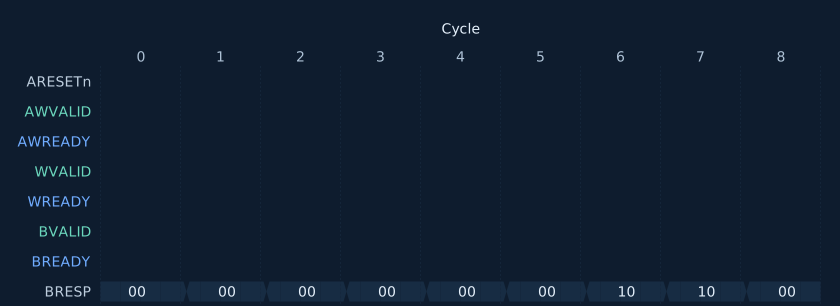
At cycle 6, BRESP changes from OKAY to SLVERR before the receiver accepts the response.
Details & downloads: Fault: the response changes while waiting
- BVALID is asserted while BREADY remains low at cycles 5 and 6.
- BRESP changes from 00 (OKAY) at cycle 5 to 10 (SLVERR) at cycle 6. The monitor reports H7F_AXI_BRESP_HOLD at cycle 6.
- The displayed bus values are the actual sampled BRESP values, including samples where BVALID is low.
Each numbered column is one supplied sample immediately before a consecutive ACLK rising edge. The clock is not drawn. Connecting lines are schematic; edge placement and behavior between samples were not measured. All eight input signals are retained, including BRESP when BVALID is low. These are hand-authored synthetic samples, not captured RTL or hardware.
Download SVG: Fault: the response changes while waitingWaveJSON source: Fault: the response changes while waiting
References: Replayable input JSON · Executed selected-check report · Checker source (MIT) · AMD PG101: selected protocol checks · Arm AXI and ACE specification, IHI 0022H
Rendered with WaveDrom 3.7.0 · Open-source notices
Synthetic example · not a hardware measurement
Scroll sideways to see the full diagram
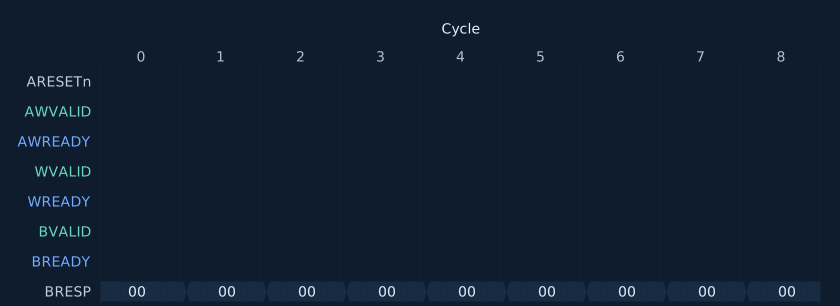
The response is accepted at cycle 3. The write data is not accepted until cycle 4.
Details & downloads: Fault: a response arrives before write data
- AW is accepted at cycle 2. BVALID is already asserted and accepted at cycle 3, before the W handshake at cycle 4.
- The monitor reports H7F_AXI_B_AFTER_AW_W at cycle 3. Both address and data must have earlier unmatched handshakes before BVALID.
- A later write-data handshake cannot make the earlier response valid.
Each numbered column is one supplied sample immediately before a consecutive ACLK rising edge. The clock is not drawn. Connecting lines are schematic; edge placement and behavior between samples were not measured. All eight input signals are retained, including BRESP when BVALID is low. These are hand-authored synthetic samples, not captured RTL or hardware.
Download SVG: Fault: a response arrives before write dataWaveJSON source: Fault: a response arrives before write data
References: Replayable input JSON · Executed selected-check report · Checker source (MIT) · AMD PG101: selected protocol checks · Arm AXI and ACE specification, IHI 0022H
Rendered with WaveDrom 3.7.0 · Open-source notices
03 / BEFORE ENUMERATION
Collect the events before drawing conclusions.
For a missing PCIe card, start with measured power, clock, reset, configuration and host events. These bands are a checklist, with no assumed timing or required order.
Illustrative bands · no timing scale or assumed order
Scroll sideways to see the full diagram
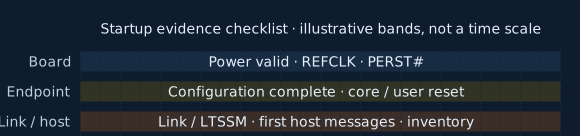
Collect board, endpoint and host events on one measured timeline. These bands show what to collect.
Details & downloads: Build one startup record across three evidence bands
- Board evidence: measure power validity, reference-clock stability and PERST# assertion/deassertion at the actual interface, with its documented polarity.
- Endpoint evidence: record FPGA configuration completion and the applicable core or user reset release. Programming success alone does not establish readiness for host configuration requests.
- Link and host evidence: record link-up or documented LTSSM evidence alongside the first relevant host messages and the enumerated inventory.
- Correlate the actual events in a measured timeline. These bands are a collection checklist; they deliberately do not draw an assumed legal power/reset waveform or prescribe an event order.
Illustrative evidence bands, not measured signals or a required sequence. Their equal spans do not establish durations, simultaneity, polarity or ordering. On the real board, place measured power, clock, reset, configuration, link and host events on a shared timeline; identify inferred or unavailable observations. Use the timing requirements for the exact FPGA, IP release, board and host. There is no universal “100 ms” patch.
Download SVG: Build one startup record across three evidence bandsWaveJSON source: Build one startup record across three evidence bands
References: FPGA missing from lspci: readiness investigation · AMD PG054: readiness during enumeration · AMD PG054: configuration and reset timing requirements · AMD PG054: scope of closed-system workarounds
Rendered with WaveDrom 3.7.0 · Open-source notices
Put the pattern to work.
Use the backpressure guide to check what happens when your receiver waits. Each diagram’s details include a downloadable image, source and supporting evidence.